

For decades, researchers, physicians and the public alike have searched for the secret to living to 100, hoping to uncover the healthy diet or daily routine that explains exceptional longevity. But the lives of the world’s oldest people suggest the answer is far more complex and interesting than any single piece of advice.
Their stories reveal a rich picture of resilience, routine, relationships and adaptation across remarkably long lives. Read on to learn more.
What’s the Secret to Living to 100?
The short answer is simple: There probably isn’t a single secret. Living to 100 is typically the result of many factors interacting across an entire lifetime:
- Genetics influence disease risk and resilience.
- Environment shapes opportunities and exposures.
- Lifestyle choices affect health outcomes.
- Social and economic conditions matter, too.
Centenarians represent a unique population because they’ve successfully navigated biological aging, along with decades of changing social, economic and environmental conditions. This also explains why two people with similar habits may experience very different outcomes.
A person who exercises regularly can still develop a chronic disease later in life. Another may reach their 100th birthday despite habits that appear inconsistent with conventional health advice.
Instead of searching for one answer to a longer lifespan and healthy aging, it’s more useful to study patterns that emerge across thousands of validated lives.
What Centenarians Have in Common
While patterns aren’t universal rules, the experiences of verified centenarians do reveal a few recurring themes:
- Routine and consistency: Many centenarians maintain remarkably consistent daily routines. Regular meal times, familiar social interactions, predictable sleep schedules and moderate activity create rhythms that reduce stress and support overall health in the long run.
- Strong social ties: Relationships, from family connections and religious communities to neighbors and social groups, appear repeatedly in centenarian stories. These connections provide emotional support and a sense of belonging.
- A sense of purpose: Many of the world’s oldest people continue to feel needed long into their old age, whether that purpose comes from work, volunteering, caregiving, hobbies, community involvement or personal values.
- Resilience through hardship: Today’s centenarians have lived through everything from wars and economic crises to pandemics and enormous technological change. Periods of hardship require adaptation and perseverance, and the ability to cope with challenges and recover from setbacks appears repeatedly in centenarian stories.
- Moderation over extremes: Maybe surprisingly, many centenarians don’t describe highly restrictive lifestyles. Instead, they often report moderation — moderate eating habits and activity, regular rest and sustainable routines maintained over many decades.
Ultimately, healthy longevity appears less associated with extremes and more associated with consistency.
Real Stories From People Who Lived Past 100
The most fascinating lesson from longevity research may be that no two stories are alike. Here’s what just a few interviews and field research from LongeviQuest visit reports reveal:
In an interview conducted at age 110, Kyōko Mizoguchi of Chiba Prefecture, Japan, shared memories spanning more than a century of change. A lifelong practitioner of the tea ceremony, she remained active well into her 90s and continued many familiar routines into later life. This highlights the importance of consistency and social connection, often seen among supercentenarians.
Italian supercentenarian Primo Olivieri, once the world’s fourth-oldest living man, received his longevity award with warmth and humor during a visit documented by researchers. His story reflects another recurring theme among many centenarians and supercentenarians: the importance of staying engaged with family, visitors and community life.
Another example comes from Shitsui Konishi of Ibaraki Prefecture, who lived independently until age 110 with support from her family. Having endured war, widowhood and the challenges of postwar Japan, her story exemplifies the resilience and adaptability typically seen in the lives of exceptionally long-lived individuals.
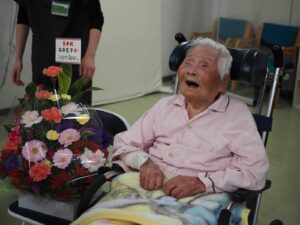
Hanako Ishii fondly recalling childhood memories
Science vs. Reality in Longevity Research
Scientific studies provide valuable insights into healthy aging and longevity, but real life is often messier than research headlines suggest.
Studies regularly identify associations between:
- Healthy diets
- Regular physical activity
- Social engagement
- Longer life expectancy
While these findings are important and well supported, not everyone who follows these practices reaches 100 years old, and not everyone who celebrates their 100th birthday follows these practices.
That’s one reason longevity science keeps evolving.
Today, the growing centenarian population provides researchers with valuable opportunities to better understand long-term aging. The U.S. Census Bureau reveals the number of centenarians doubled between 2010 and 2020, and projections from the Pew Research Center suggest the population could quadruple over the next three decades.
Validated longevity data helps connect scientific research with real-world experience, and the LongeviQuest database makes it possible to examine patterns across countries, cultures and generations.
Why There’s No Single Secret to Longevity
Longevity is ultimately a product of biology, environment, opportunity and chance interacting over time:
- Genetics clearly plays an important role. Some individuals appear to possess biological advantages that support healthier aging or resistance to disease.
- Environmental factors matter, too, with access to healthcare, nutrition, education, clean environments and social support influencing outcomes across entire populations.
- Culture also shapes longevity through everything from family structures and social expectations to work patterns and dietary traditions.
Yet, even among people with similar lifestyles, outcomes can vary considerably. That’s why searching for a single “secret” can be misleading. Human aging is one of the most complex processes in biology, and exceptional longevity reflects that.
The more valuable question may not be, “What’s the secret to living to 100?” but rather, “What can we learn from studying different centenarian lives?”
The Secret to Living to 100 FAQs
Why do some people live to 100 without following “healthy” lifestyles?
Genetics, environmental factors and random biological variation all contribute to aging outcomes. Lifestyle matters, but it’s only one piece of a larger picture.
Are there Blue Zones, and do they really matter?
Blue Zones are regions associated with unusually high concentrations of long-lived individuals. They offer useful insights into community structure and lifestyle patterns, but they should not be interpreted as guarantees or universal models.
Do centenarians tend to live in rural or urban areas?
Both environments produce centenarians, with validated cases everywhere from Tokyo to tiny Sardinian villages. Today, exceptional longevity has been documented in villages, suburbs and major cities around the world.
Does gender affect the likelihood of living to 100?
Yes. Women significantly outnumber men among centenarians in most countries, although the reasons remain an active area of research.
Can lifestyle changes in midlife still impact longevity?
Absolutely. Research suggests that improvements in physical activity, diet, sleep and social engagement can provide health benefits even later in life.
What’s the difference between a centenarian and a supercentenarian?
A centenarian is someone who reaches the age of 100. A supercentenarian is someone who reaches age 110; an achievement attained by only a tiny fraction of the population.
How do researchers collect data on people who live to 100?
Validation rests on a chain of records that span early, mid and late life. LongeviQuest calls this principle lifelong consistency of identity. Throughout the process, evaluators cross-reference documents, interview relatives and reject any claim that relies on a single piece of evidence.
Rethinking the Idea of a “Secret” to Longevity
The lives of verified centenarians suggest that longevity isn’t the result of one food, exercise routine, supplement or lifestyle philosophy. Instead, it comes from decades of interconnected choices, relationships, environments and circumstances.
By studying centenarians and supercentenarians, researchers gain deeper insight into the limits of human longevity and the factors that may contribute to exceptional survival. As the authority on validated human longevity records, LongeviQuest continues to document these lives, preserve their histories and advance the world’s understanding of human aging.
Interested in exploring the world’s longest-lived individuals? Browse verified records in the LongeviQuest database, use our Longevity Score tool or submit a claim to contribute to future research.