The female titleholder
Why do women live longer?
So what makes women live longer than men? There are several reasons, many of them quite complex. We can begin with the fact that the majority of children born are male. It is not a large majority with about 105 boys are born for every 100 girls, but it is a majority nonetheless. It is only later in life that women catch up to and eventually surpass men in number. Men tend to die at higher rates due, in part, to lifestyle factors. In general, men are more likely to engage in risky behaviors such as physical confrontations, reckless driving, smoking, and heavier alcohol consumption. Women also tend to be more proactive about their health: they are often more attentive to signs of illness, more likely to seek medical care, and more likely to schedule regular appointments with their physicians.
Historically, men have generally worked in more dangerous and physically demanding jobs such as railroad work, construction, and mining, which carry a higher risk of accidents as well as long-term physical “wear and tear.” There are also biological factors. Having two X chromosomes may serve as a protective factor, since individuals with one X and one Y chromosome do not have a second X chromosome that can compensate for potentially harmful genetic variants on the other. The Y chromosome is also much smaller than the X chromosome and contains far fewer genes. Hormones may play a role as well. Estrogen, which is more abundant in most women, has been linked to protective effects on the cardiovascular system. Testosterone (often considered the primary “male” hormone) has been associated with greater risk-taking behavior and higher levels of aggression, which can contribute to higher mortality rates. Body size also appears to play a role in longevity.
I will not go into additional reasons in this editorial, but there are more. It should also be emphasized that factors beyond biology play a role. Cultural views on sex and gender, gender norms, social constructs, and traditions are not constant. What was considered typically “female” or “male” a century ago, or even a decade ago, is not necessarily the same today and may change again in the future. This discussion is therefore a broad generalization.
Female supercentenarian pioneers/barrier breakers
Ruth Apilado (1908–2022) was a journalist who fought against racism and advocated for African American civil rights. She initially worked as a teacher, but in 1973 she founded America’s Intercultural Magazine (AIM), a publication dedicated to combating racism and discrimination. Apilado had begun her journalistic career several decades earlier and, over the years, highlighted the inequalities African Americans faced in the United States. She continued contributing to the magazine until its discontinuation in 2007 and remained a sought-after voice for her insights up until her death at age 113.
Edith Renfrow Smith (1914–2026) broke barriers as the first African American woman to graduate from Grinnell College in Iowa, earning her degree in 1937. She was the grandchild of enslaved people who had moved to Iowa in the 1800s seeking freedom. From a young age, her mother instilled in Renfrow Smith and her siblings the importance of education and equality, lessons they carried throughout their lives. To pay for college, she worked as a secretary and was the only Black student at Grinnell during her years there, excelling in academics and sports. After graduating with a degree in psychology, she worked at the YWCA, supporting women with housing and employment, and later pursued a career as a teacher.
Final remarks
Female supercentenarians, while often coming from a socially disadvantaged position, have an advantage as they encompass the majority of all supercentenarians. Many have also led noteable lives beyond their age, making contributions in various fields, helping pave the way for future generations of women.
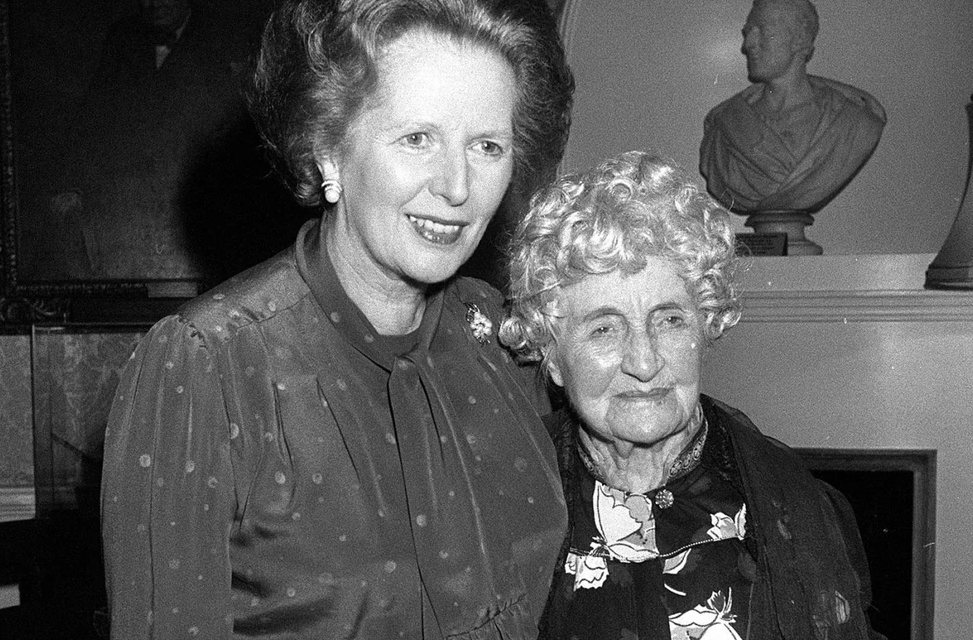
Featured Image: Charlotte Hughes (1877-1993) with former UK Prime minister Margaret Thatcher (Source: PA Images)