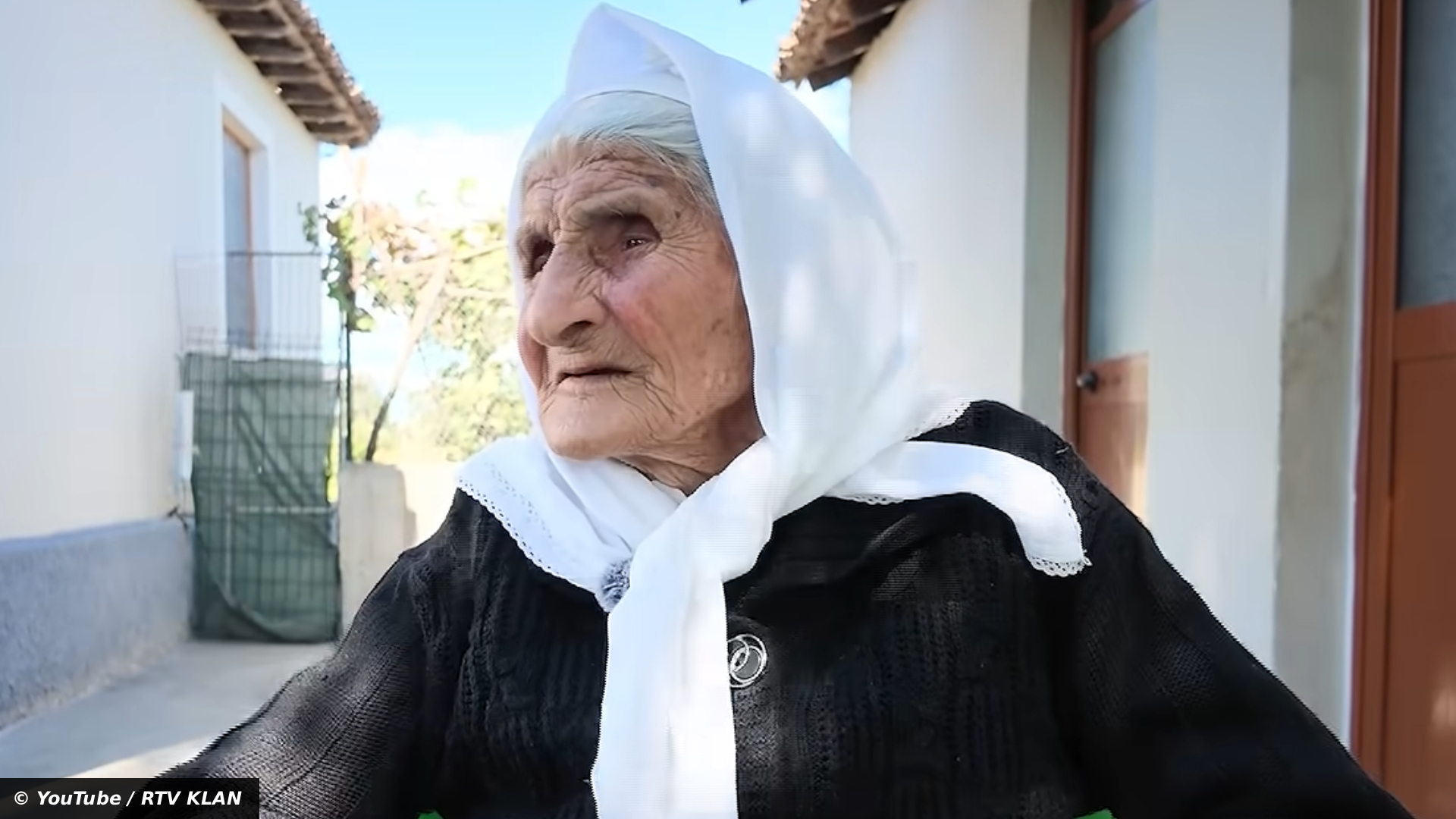
Recently, following the 117th birthday of the world’s oldest living person, British woman Ethel Caterham, several news outlets reported that a new claimant to the title had been identified in Albania. Qamile Marra, a resident of the small village of Ferras in the Kuçovë District of Albania, claims to have been born on 19 August 1909, which would make her two days older than Caterham, who is currently recognized as the world’s oldest living person.
In 2023, it was reported that Marra had six children, four daughters and two sons, and that her eldest daughter was 85 years old. She reportedly worked for 35 years in an agricultural cooperative and said that she had consumed dairy products throughout her life. At the time, she was also reportedly still doing housework and washing her own clothes. She lived with her 76-year-old youngest son and her 68-year-old daughter-in-law.
Televizioni Klan, a private Albanian television network based in Tirana, recently released a video report about Marra on its YouTube channel, which has more than 2.2 million subscribers. The report displayed two of her identity documents, including an old identity card issued during the period of the People’s Socialist Republic of Albania (1976–1991). The document was issued on 2 June 1978 and states that she was born on 19 August 1909 to parents Metan and Sheja in the village of Kozare, in Berat County. The second document presented in the report was a modern identity card.
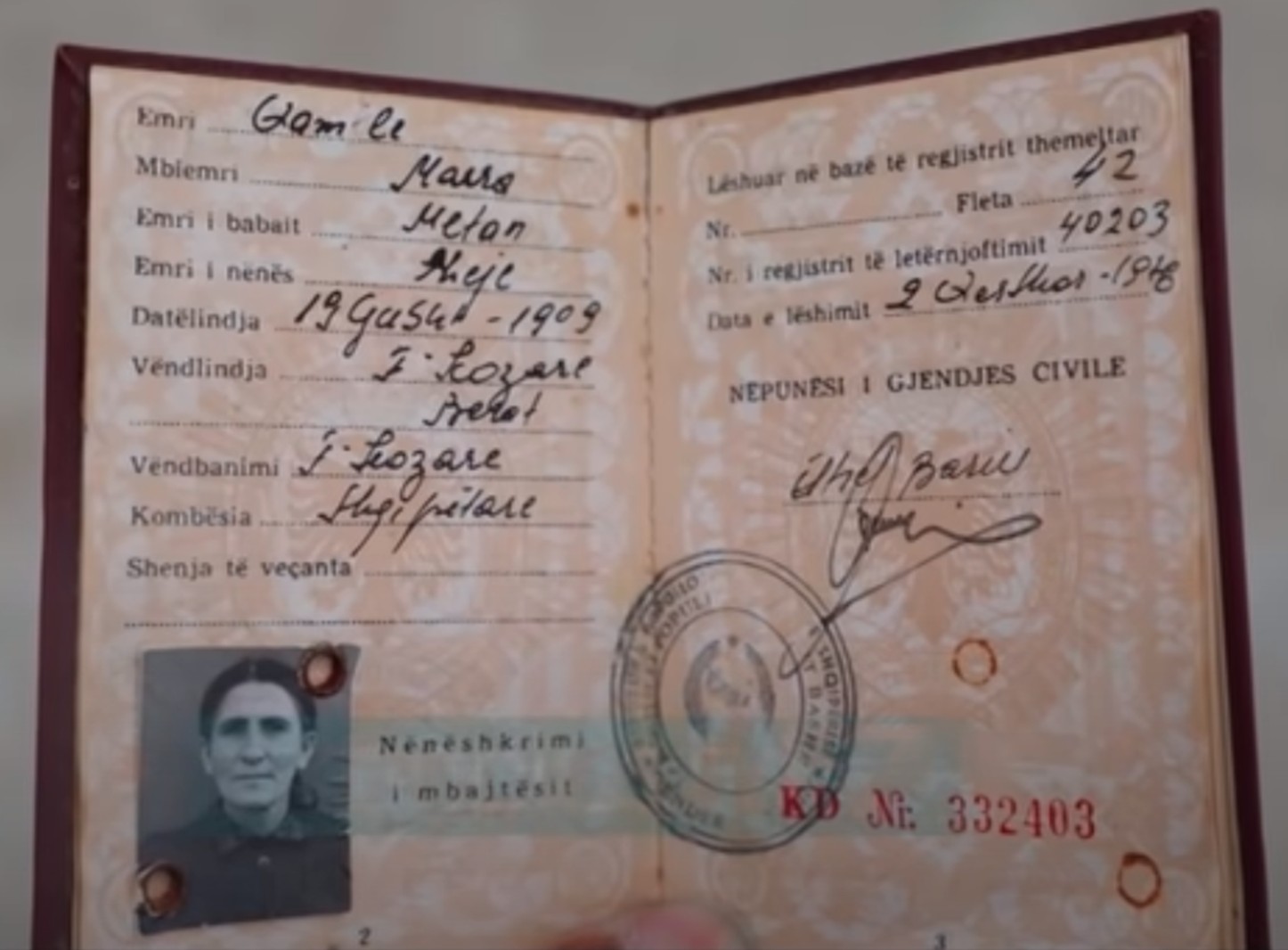
Old ID card, issued in 1978.
Research Efforts
LongeviQuest has received multiple applications concerning this case, with these two documents frequently attached as supporting evidence. However, the evidence presented so far is not sufficient to validate her claimed age or recognize her as the world’s oldest living person.
LongeviQuest’s validation process involves locating and obtaining documentation from different stages of a claimant’s life. The most important document is one dating from the first 10 years of the claimant’s life, usually a birth or baptismal record or an early census record. A second document should come from mid-life, such as a marriage record, census record, or a child’s birth record. This document must also support any change of name, such as a surname change following marriage. Finally, a modern document, such as a currently valid identity card, is generally required to establish continuity to the present day.
While the case of Qamile Marra does include some factors that could lend support to her claim, such as the fact that her oldest children were 85 and 76 years old, respectively, in 2023, which could indicate that she was already in her 100s at the time, an early-life document is necessary to establish her exact age with certainty.
In 1909, when she was allegedly born, Albania was still part of the Ottoman Empire, and birth registrations may not have been consistently maintained in rural areas. The first official census was conducted on 15 November 1923 and was limited to a basic population count. As information about the ages of citizens was not available at the time, only the main demographic characteristics of the population were recorded. Given these circumstances, it is difficult to determine what might be the earliest surviving document that could potentially be located for Marra.
To date, no supercentenarian from Albania has been validated, largely due to a lack of early-life documentation.