
“Am I 113?”
When I asked Koyū Morita (森田コユウ) about the secret to her long life, she first seemed surprised by her own age.
“Yes, you’re 113,” I replied.
“Are you surprised?” her daughter-in-law asked.
“Yes,” she answered, bringing a moment of shared amusement to the conversation.
We visited Morita, Osaka Prefecture’s oldest living resident, on 24 October 2026, at Kirakira, her care home in Matsubara, Osaka. Throughout our visit, she listened as her family spoke and responded at her own pace, sharing memories of work, making clothes, and providing for herself.
Born in Okayama Prefecture on 12 July 1913, Morita moved to Fukuyama, Hiroshima Prefecture, after marrying at 19. After her husband died of illness during World War II, she raised three sons while farming and doing forestry work. In her 70s, she moved to Matsubara, Osaka, to live with her second son’s family. She continued knitting until around the age of 100.
“I Do What I Can on My Own”
Asked about the secret to her long life, Morita replied, “Nothing in particular. I try to do what I can on my own. That’s all.”
“She always held herself to high standards,” her daughter-in-law added.
Morita returned to this idea several times during our conversation. Her examples came from everyday life: growing food, sewing clothes, and making bedding.
“I had a small field where I grew all sorts of things to eat,” she recalled.
As we talked about growing food and making clothes, she added:
“I bought rice, though. I bought soy sauce, vinegar, and sugar, too.”
She bought what she needed and made what she could.
“I tailored and sewed my own kimono to wear. I did all sorts of things,” she said.
She also sewed futons and filled them with cotton. Making clothes and bedding herself was part of her everyday life.

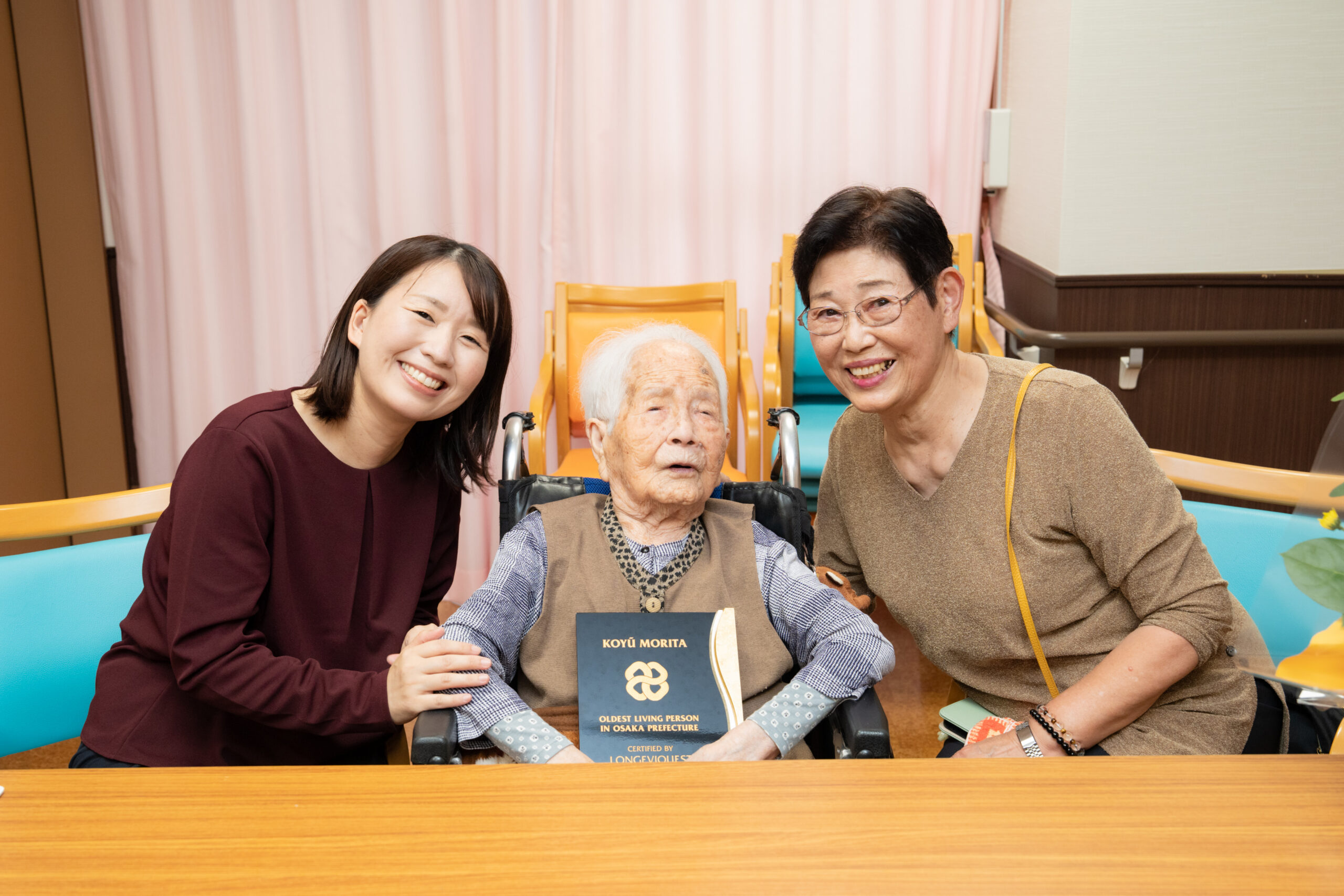
Koyū Morita (森田コユウ) shares a gentle smile during LongeviQuest’s visit on October 24, 2026.
From Sheep’s Wool to Clothing
Morita began knitting before she married. She made gloves, hats, and other garments—and her work began well before the knitting itself.
“I spun sheep’s wool into yarn, dyed it myself, and then knitted with it,” she explained.
In another part of the conversation, she recalled washing and dyeing the wool. Making something to wear involved a whole sequence of tasks, each completed by hand.
“I did whatever my body would allow me to do. Farming, mountain work, too,” she said.
Although she now says she can no longer do those things, she was eager to encourage others to learn.
“You can all do it. Please give it a try.”
She urged us to ask older people to share their knowledge while they were still here to teach it.
Her advice was rooted in the life she had described: learn from someone who knows, then try doing what you can yourself.
Surprised by Her Own Longevity
At the time of our visit, Morita was the sixth-oldest living person in Japan and the twentieth-oldest in the world.
When I told her her world ranking, Morita asked:
“Twentieth?”
“There are still that many people ahead of me?”
When encouraged to aim for the top spot, she replied, “Oh, no, I’ve lived long enough,” prompting laughter from her family.
Later in the conversation, she remarked:
“The twentieth oldest? Have I really lived that long? How strange.”
“It’s amazing, isn’t it? You’ve just been living your life, and here you are at 113,” her daughter-in-law said warmly.
Her surprise seemed to run both ways: that she had lived so long, and that there were still so many people older than her.
“Your smile gives so many people encouragement,” I told her.
She let out a warm laugh.
Recognizing Through Touch
Morita has very limited vision because of cataracts. Her family says she can tell whether a hand belongs to a family member by touch.
When I took her hand in greeting, she described mine as “gentle little hands.” Her words immediately put me at ease.
She also seems able to tell by touch whether a garment is something she knitted herself. When we held a knitted vest in front of her, she ran her fingers over the fabric, feeling its texture.

Koyū Morita (森田コユウ) feels the texture of a vest she knitted herself during LongeviQuest’s visit on October 24, 2026.
We had brought flowers to celebrate her longevity. With her daughter-in-law’s help, Morita reached out to touch them, feeling their texture.
“Beautiful flowers,” she said.
“The flowers are beautiful, aren’t they, Grandma?” her daughter-in-law replied.
Morita agreed, then asked, “Please put them somewhere we can enjoy them.”
“Yes, we will,” her daughter-in-law said.
“Thank you,” Morita replied.
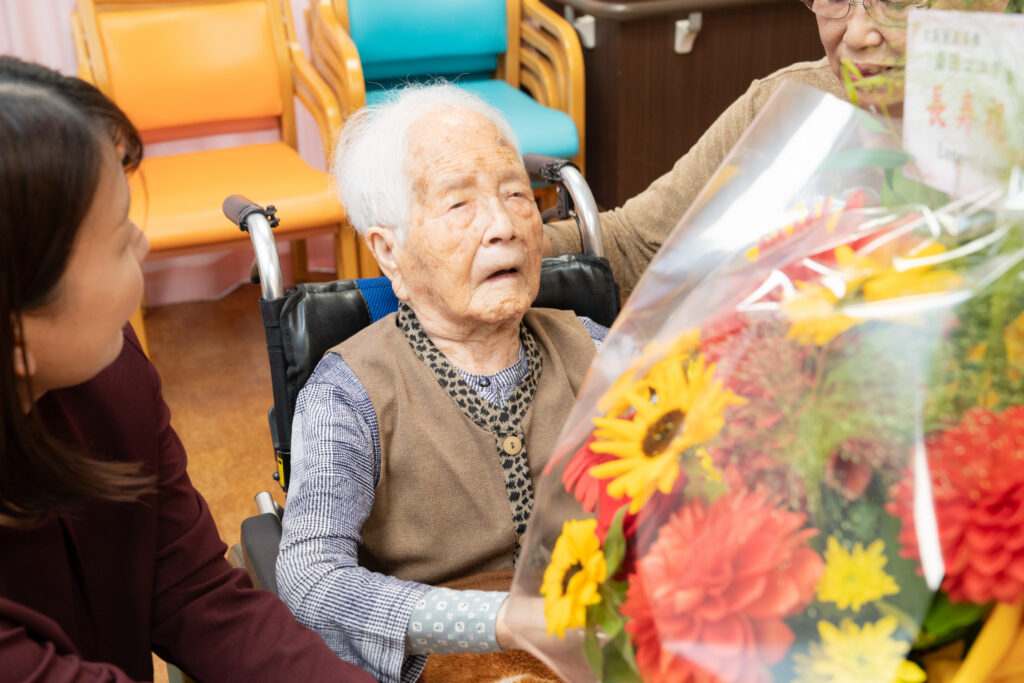
With her daughter-in-law’s help, Koyū Morita (森田コユウ) feels the flowers presented by LongeviQuest on October 24, 2026.
We also presented a plaque recognizing her as Osaka Prefecture’s oldest living person.
“This is proof that you’re the oldest in Osaka,” her daughter-in-law explained affectionately.
As her daughter-in-law described the plaque and encouraged her to open her eyes, Morita opened them wide.
As our visit drew to a close, I thanked Morita for sharing her stories. “She’s so glad she could talk with you,” her daughter-in-law told her.
“Thank you,” Morita said.
“I hope we can meet again next year,” I told her. “Please stay well.”
“Thank you,” she replied once more.
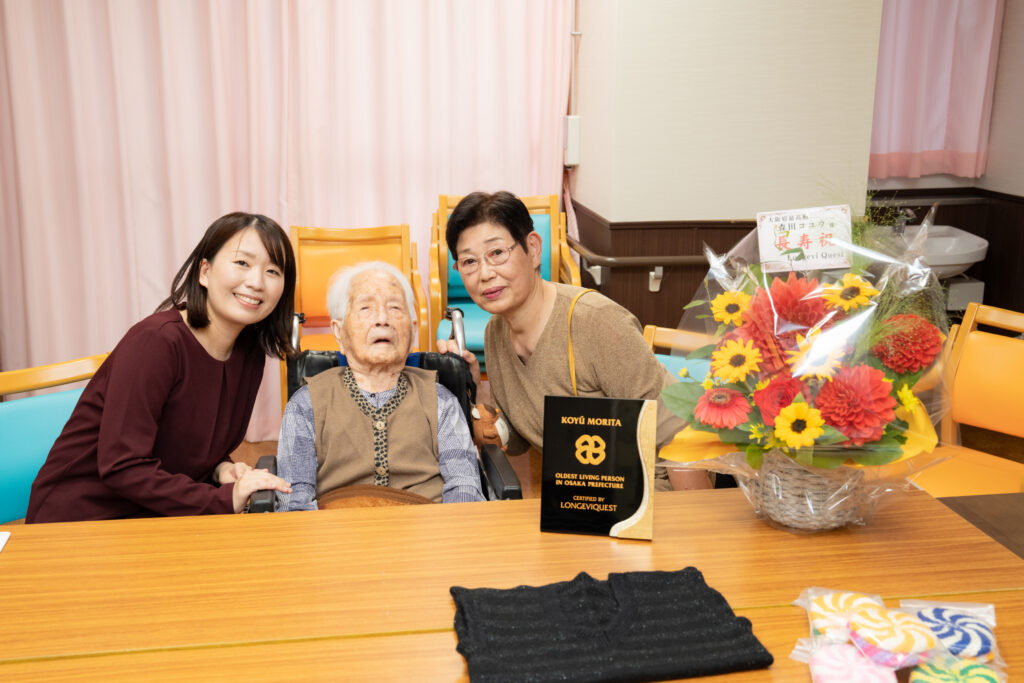
Koyū Morita (森田コユウ) during LongeviQuest’s visit on October 24, 2026. On the table are her recognition plaque, flowers, and the vest and yarn scrubbers she knitted.
What stayed with me after the visit was not only Morita’s many expressions of thanks, but also the warmth with which her daughter-in-law and granddaughters spoke to her. Her daughter-in-law visits twice a week, spending about an hour chatting with her each time. Her granddaughters and great-grandchildren also visit at least once a month, bringing company and encouragement.
Seeing them together, I felt that her family’s warmth and the comfortable life she enjoys at Kirakira help her stay well and keep smiling.
LongeviQuest thanks Mrs. Morita, her family, and the staff at Kirakira for their warm welcome and wishes Mrs. Morita continued good health and happiness.
Our video of the visit will be released soon. Stay tuned!


