Background
Previous centenarian research has indicated that centenarians with higher ability to perform activities such as chair rises and other activities of daily life (ADL) have a higher survival rate than less robust centenarians (Alvarez et al., 2021). Alvarez et al. studied Danish centenarians born in 1905 and 1910 and identified three groups of centenarians: robust, intermediate and frail, based on ability to rise from a chair, cognitive function (Mini-Mental State Examination, MMSE), self-rated health and ability to perform activities of daily life (ADL, Katz' disability score).
Robust centenarians were the strongest within the group and rated the highest in all tests, with all robust centenarians being able to rise from a chair, most of them without help. Likewise, robust centenarians were generally not severely disabled, with about half being moderately disabled and the rest having no disability. Intermediate centenarians were almost exclusively unable to rise from a chair, and if they were able to rise, they did so with their arms. Intermediate centenarians were mostly disabled with only some having moderate disabilities. Finally, frail centenarians were unable to stand and almost all were disabled.
Interestingly, Alvarez et al studied survival after age 100 in the centenarian groups. Robust centenarians had a probability of survival to age 105 of 0.12 and 0.17 for the 1905 and 1910 cohorts. Intermediate centenarians had a probability of survival to age 105 of less than 0.10 for both cohorts and for frail centenarians none from 1905 and only 0.03 survived to 105. One robust centenarian born in 1905 lived to become a supercentenarian (most probably Signe Højer) and none born in 1910 made it to 110.
Still, supercentenarians are something else.
LongeviQuest Research on Standing in Supercentenarians
A group of researchers here at LongeviQuest studied supercentenarian reports in media and biographies for a multitude of predetermined variables. The methodology included searching for news reports, available and submitted information on the 150 oldest female and the 150 oldest male validated deceased supercentenarians of all time as of Summer 2024.
93% of supercentenarians were reported in media at least once and information on ability to stand was available for 259 supercentenarians, although there were a few instances of uncertainty on ability.
Female and male centenarians and their ability to stand at ages 100 and 110 were compared using Chi^2-analysis.
Table 1. Comparison of the 150 Oldest Female and 150 Oldest Male Validated Supercentenarians
|
Variable |
150 Oldest Women % Yes |
Missing (n) |
150 Oldest Men % Yes |
Missing (n) |
χ² |
p sex difference * |
|
Median Age |
114.73 |
0 |
111.48 |
0 |
- |
- |
|
Age 100 Stand |
98.5 |
16 |
98.4 |
24 |
1.895 |
0.169 |
|
Age 110 Stand |
64.2 |
16 |
89.6 |
25 |
23.211 |
< 0.001 |
For each group, missing data were excluded before calculating the proportion of “yes” responses. Differences between the groups were analyzed using a Chi²-test, and Chi²-value (χ²) was calculated. Significance level was set at p < 0.05.
What emerged from the data was that the overwhelming majority of supercentenarians would be considered robust at age 100, going solely by ability to stand. Of the 134 female and 126 male supercentenarians, a total of 132 female and 124 male supercentenarians could stand up at age 100 (about 98.5 percent for both sexes).
At age 110 a clear difference had emerged between the two groups, with 86 female supercentenarians (64.2 percent) and 112 male supercentenarians (89.6 percent) still being reported to be able to stand (p < 0.001).
At the same time, the median age for female supercentenarians (114.73 years) was more than three years higher than that of male supercentenarians (111.47 years).
As noted above, there existed uncertainties on ability to stand for some supercentenarians and for several supercentenarians ability to stand at age 100 was based on ability to stand at age 110 and reports from intermediary years, meaning that the results must be interpreted with caution. Few supercentenarians were able to stand/walk without assistance.
Discussion
That most supercentenarians were able to stand age 100 is not that surprising given that these individuals would live for at least another decade and thus had to be relatively robust and able to stay active. The interesting finding from the data is the male advantage in ability to stand at age 110 combined with a female advantage in survival to higher ages.
Previous research (e.g., Hägg & Jylhävä, 2021; Jylhävä et al., 2017) have highlighted a paradox in survival where women are frailer and in worse health than men towards end of life but still outlive them. These studies highlight that there are biological sexes between sexes, such as women possessing an extra X-chromosome and there being variations in a variety of hormones that can affect both cells and the physical functioning of the human body. Hägg & Jylhävä noted that the interaction between several processes are still uncertain but that women are better at maintaining cellular and molecular mechanisms than men. Given the results of the LQ study it appears evident that these sex differences remain even at exceptional ages.
Still, a common event preceding supercentenarians passing away is falls and other forms of physical trauma. Osteoporosis is common in the exceptionally old, and can predispose such events and result in severe injuries, including internal bleeding (Meyer et al., 2019; Zwart et al., 2023). Falls may thus play a role, as it could result in either permanent disability or death, but more research on exact causes of death in supercentenarians remains to be investigated.
Notable Exceptions
While most supercentenarians were able to stand at advanced ages there are always exceptions. Perhaps most notable is Sarah Knauss who became unable to stand around age 100 but would still live to age 119, being the oldest American supercentenarian of all time. The oldest people still able stand were women, with Kane Tanaka (1903-2022), Violet Brown (1900-2018), and Emma Morano (1899-2017) all being able to move about to some degree at age 117. Jeanne Calment, the oldest person ever, was still able to walk mostly on her own until she suffered a fall shortly before age 115.
Conclusion
Most of the oldest validated supercentenarians of all time were able to stand at age 100, but the ability to stand at age 110 declined more in female than in male supercentenarians. Nevertheless, female supercentenarians lived more than three years longer than their male counterparts, indicating that the frailty-paradox in which women outlive men despite having a higher degree of frailty appears to exist even among supercentenarians.
References
Alvarez, J. A., Medford, A., Strozza, C., Thinggaard, M., & Christensen, K. (2021). Stratification in health and survival after age 100: evidence from Danish centenarians. BMC geriatrics, 21(1), 406. https://doi.org/10.1186/s12877-021-02326-3
Hägg, S., & Jylhävä, J. (2021). Sex differences in biological aging with a focus on human studies. eLife, 10, e63425. https://doi.org/10.7554/eLife.63425
Jylhävä, J., Pedersen, N. L., & Hägg, S. (2017). Biological Age Predictors. EBioMedicine, 21, 29–36. https://doi.org/10.1016/j.ebiom.2017.03.046
Meyer, F., König, H. H., & Hajek, A. (2019). Osteoporosis, Fear of Falling, and Restrictions in Daily Living. Evidence From a Nationally Representative Sample of Community-Dwelling Older Adults. Frontiers in endocrinology, 10, 646. https://doi.org/10.3389/fendo.2019.00646
Zwart, L., Germans, T., Vogels, R., Simsek, S., Hemels, M., & Jansen, R. (2023). Frail patients who fall and their risk on major bleeding and intracranial haemorrhage. Outcomes from the Fall and Syncope Registry. BMC geriatrics, 23(1), 422. https://doi.org/10.1186/s12877-023-04120-9
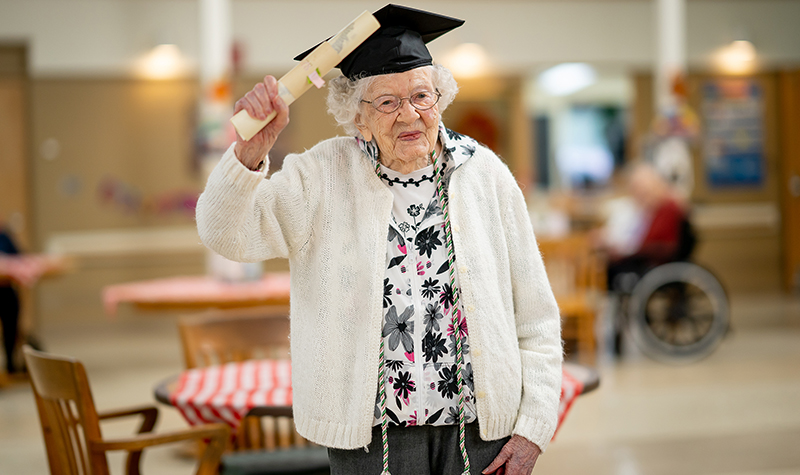
Featured image portrays Iris Westman (1905-2021) standing up at age 114. Source: Sam Melquist, UND Alumni Association & Foundation.