Masao Kadoguchi (Japanese: 門口正雄) was a Japanese supercentenarian who, at the time of her passing, was the oldest living man in Nagasaki Prefecture, and one of Japan’s oldest living men.
Ruby Davis, Missouri’s Oldest Resident, Dies at 111




Masao Kadoguchi, during the mayor’s visit in September 2025 (Source: Asahi Shimbun).
✔ Age Certified by LongeviQuest
Loading...
Masao Kadoguchi (Japanese: 門口正雄) was a Japanese supercentenarian who, at the time of her passing, was the oldest living man in Nagasaki Prefecture, and one of Japan’s oldest living men.
Masao Kadoguchi (門口正雄) was born in Kagawa Prefecture, Japan, on 7 September 1915. In his early twenties, he worked at a hotel in Hong Kong, where he fell in love with a Japanese woman who was working alongside him. The two married in Hong Kong. After their first daughter and son were born, the family returned to Japan before the end of World War II and settled in Nagasaki Prefecture, his wife’s hometown. The couple eventually raised a family of six children.
Kadoguchi was known as a devoted family man who especially treasured his wife, showing his affection not only through words but also through daily acts of care. In order to ease his wife’s burden of managing the household and raising six children, he actively helped with chores such as scrubbing floors and cleaning—an uncommon role for men in Japan at the time. He also took care of his own needs, ironing his own dress shirts and handling personal matters by himself. This independence and thoughtfulness reflected not only his self-reliance but also his deep affection and respect for his wife. His children remembered him as a kind father who built a swing and slide in the garden and would quietly ask what they wanted so he could surprise them with thoughtful gifts.
One of his defining traits was his consistent approach to diet. A great lover of fish, Kadoguchi ate fish twice a day—every morning and evening—for 365 days a year, up until the age of 106, while living at home. During the years when his wife was alive, she supported this routine by visiting the morning market daily to buy fresh fish. In the mornings, he enjoyed grilled fish, and in the evenings, sashimi. He also enjoyed drinking sake—his daily routine included sipping one and a half glasses of sake over two hours while savoring two servings of sashimi. As side dishes for his nightly drinks, his wife, who was an excellent cook, always prepared two or three small plates, and Kadoguchi especially loved the meals she made. After his wife’s passing, his eldest daughter carried on this role, recreating the familiar flavors of her mother’s cooking and supporting his meals every day. He also made it a point to eat two or three pieces of grilled eel every evening without fail. He valued a way of eating in which he would watch sumo or baseball on TV while taking his time, chewing each bite carefully and eating little by little. This is a habit he continues to hold dear, and even at the age of 110, he still eats all three of his daily meals slowly and with thorough chewing.
Although he did not snack, his lunch was typically light—hot milk accompanied by bread or sweet buns. He long maintained the practice of eating in moderation, never more than 80 percent full, a habit he valued alongside mindful chewing.
Kadoguchi’s fish-rich diet was believed to have contributed to his strong bones and robust health, as he rarely caught colds. Living in Nagasaki, a city known for its many steep slopes, he continued walking up and down them until around the age of 100, which likely helped maintain his physical fitness.
His family described him as a highly motivated person. When he decided to raise goldfish and koi, he dug a pond in the yard himself. When he became interested in chrysanthemums and orchids, he built a greenhouse by hand and nurtured the flowers as a daily source of joy. He was also an avid sports fan and made it a habit to read both the local and sports newspapers thoroughly each day.
Kadoguchi and his wife shared a strong interest in health and nutrition, an outlook that shaped the way their family meals were prepared and enjoyed. His wife passed away at age 97, when Kadoguchi was 98.. He then lived alone with the help of his second daughter, who supported him with meals, and he sometimes cooked for himself. At age 106, he was hospitalized after a fall at home and remained in the hospital thereafter.
At the hospital, Kadoguchi was known for his affectionate personality. He remembers each nurse’s name and face, and is treated warmly, often receiving cheerful greetings like, “You’re looking handsome today!” He was also known for expressing gratitude, frequently putting his hands together to show his appreciation and always saying “thank you” after receiving care.
Even before entering the hospital, Kadoguchi had a strong sense of personal grooming. At home, he would brush his hair every time he went to the bathroom and apply plenty of hair tonic, aroutine that may have helped keep his hair thick until the age of 110.
His positive attitude was also remembered through his favorite phrase: “Ganbarimashō!” (“Let’s do our best!”), which he repeated brightly. He also valued humor, sometimes making witty remarks to bring smiles to those around him. He continued to say with gratitude, “Thanks to my second daughter, I am able to keep living this long!”
Masao Kadoguchi passed away due to acute heart failure on 27 January 2025 at the age of 110 years and 142 days at a hospital in Nagasaki City, where he was hospitalized.
Following the passing of an anonymous 109-year-old woman in Nagasaki City on 23 April 2025, Kadoguchi became the oldest known living person in Nagasaki Prefecture. Following his own passing, Motome Nakamura (born 1 December 1916) of Isahaya City became the oldest known living person in Nagasaki Prefecture.
His age was verified by Nagasaki Prefecture, Yumi Yamamoto, and Ryohei Asano, and was validated by LongeviQuest on 23 September 2025.
(All information regarding Masao Kadoguchi (門口正雄)’s biography was gathered through interviews conducted by LongeviQuest with his family.)
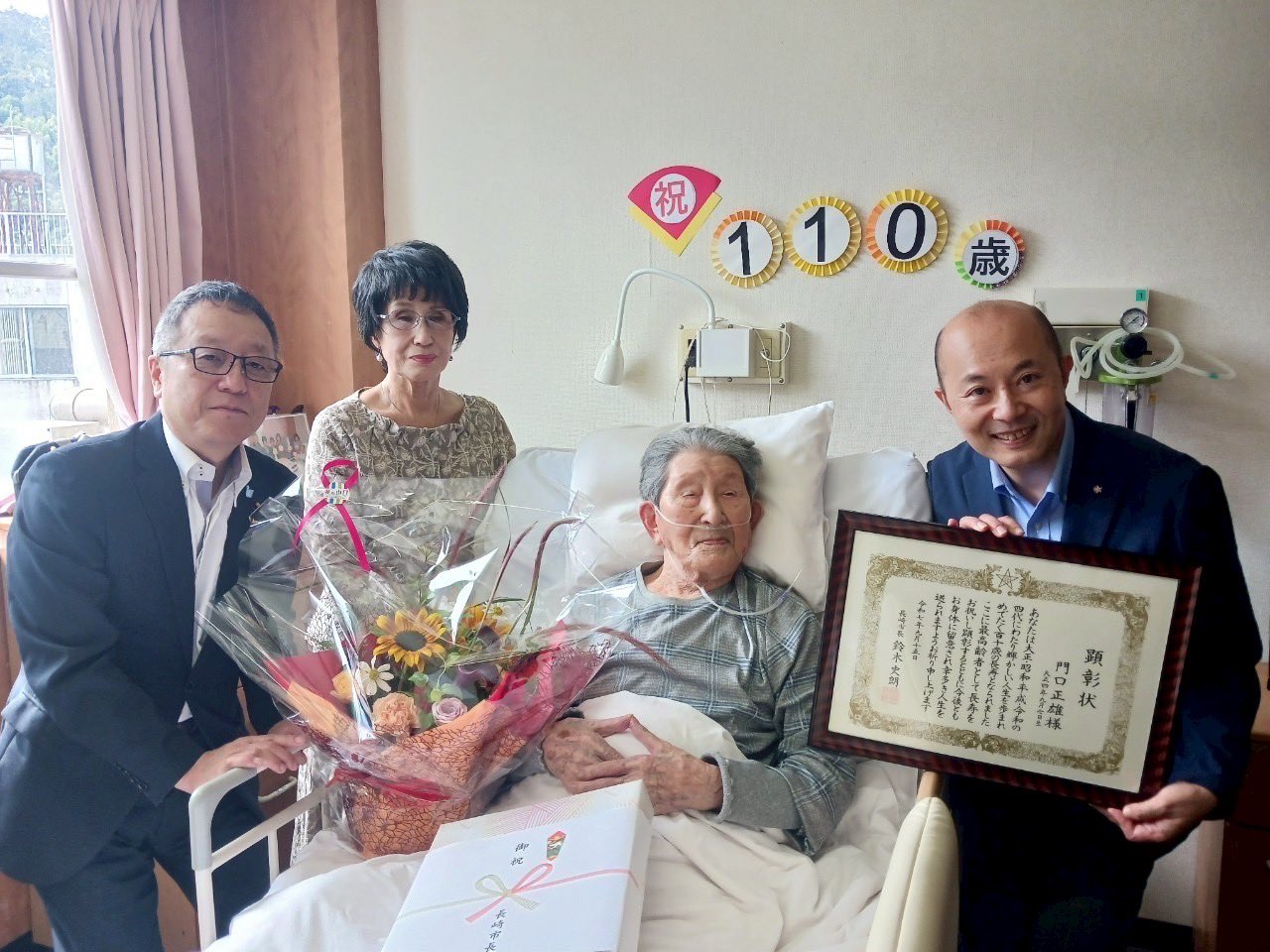
Masao Kadoguchi, during the mayor’s visit in September 2025 (Source: Asahi Shimbun).
Masao Kadoguchi, during the mayor’s visit in September 2025 (Source: Asahi Shimbun).
[crp limit=’4′ ]