
Eleanor “Nellie” Kevill was an American supercentenarian whose age has been validated by LongeviQuest.
Translate:

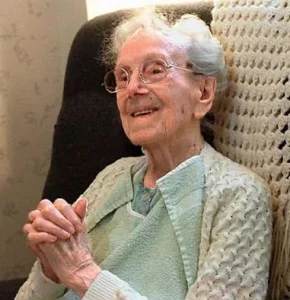
On 2 March 1989, aged 104. (Source: The Daily Item, page 11).
Supercentenarian Profile
Eleanor Kevill
✔ Age Certified by LongeviQuest
Loading...
BIOGRAPHY
Eleanor “Nellie” Kevill was born on 28 February 1885 in Lynn, Massachusetts, United States, the daughter of Owen Kevill and Bridget Carr. She attended local schools until ninth grade before going to work as a stitcher at the Brophy Brothers shoe factory, where she remained for more than a decade.
Kevill lived on Collins Street in Lynn for most of her life and was a communicant of St. Joseph’s Church and a member of the Our Lady of Fatima Sodality. She never married, often joking “not yet” when asked, and credited her longevity to never smoking or drinking.
In her later years, she often reflected on the many changes she had seen, remarking that “everything is electronic and people worked harder back then,” and lamenting that women “have to work so much today.” She lived through 20 presidential elections and named John F. Kennedy as her favorite president.
In 1988, at the age of 103, Kevill moved into Twin Oaks Nursing Home in Danvers after fracturing her pelvis in a fall. Despite the injury, she continued to enjoy good health and remained a popular and active resident, enjoying walking, singing, and visits from family.
Eleanor Kevill died at Twin Oaks on 15 September 1995 at the age of 110. At the time of her death, she was recognized as the oldest resident of Massachusetts. She was buried in St. Joseph’s Cemetery following services at St. Joseph’s Church in Lynn.
RECOGNITION
Her age was verified by Eli Logan, Jimmy Lindberg and Marco Wikkerink, and validated by LongeviQuest on 18 September 2025.
ATTRIBUTION
* “Life still has joy for Nellie Kevill” – The Daily Item, 2 March 1989
* “Lynn native Nellie Kevill is 108” – The Daily Item, 8 March 1993
* “Eleanor Kevill, 110, state’s oldest resident” – The Daily Item, 18 September 1995
GALLERY
On 2 March 1989, aged 104. (Source: The Daily Item, page 11).
RELATED PROFILES
Related posts:
[crp limit='4' ]