

Taki Sugimoto (Japanese: 杉本タキ) was a Japanese supercentenarian whose age has been validated by LongeviQuest.
BIOGRAPHY
Taki Sugimoto (杉本タキ) was born on April 17, 1859, into a farming family in Tamana District, Higo Province (present-day Tamana City, Kumamoto Prefecture), Japan. From a young age, she engaged in farm work. At the age of 28, she married and raised eight children. In order to support her family, she undertook heavy manual labor, including farm work and work in coal mines, which contributed to her physical resilience. She was widowed at the age of 51.
After her husband’s death, Sugimoto continued to live independently for many years. Even in advanced age, she maintained an active lifestyle. Until around the age of 95, she traveled on her own to visit the homes of her children and grandchildren in places such as Hiroshima and Osaka, and she also enjoyed attending theatrical performances. At the age of 98, she settled permanently in Kashima Town, Nagasaki Prefecture, where her eldest son and his family lived.
Aside from a bone fracture at the age of 102, she reportedly did not experience any serious illnesses throughout her life. She retained a strong sense of independence and continued to take care of herself well into old age. At the age of 110, she still maintained a clear determination to manage her own daily needs, and she reportedly took pride in the fact that she was not regarded as a burden by her family.
At the age of 110, her daily routine followed a consistent pattern. She woke up at 6:30 a.m. and ate breakfast, consisting of two bowls of rice, oshiruko (a sweet soup made from red beans), and pickles, before lying down again. Between 11:30 a.m. and noon, she ate lunch of two bowls of rice with fish and pickles, followed by a nap. At 5:30 p.m., she had dinner of two bowls of rice with fish and pickles, rested again, and went to bed at 8:00 p.m.
Her days largely revolved around eating and sleeping. Although she had lost her teeth, she did not avoid any particular foods and ate the same ordinary meals as her family. She was said to follow the traditional principles of “early to bed, early to rise, and eating to about eighty percent full,” and reportedly lived without regular need for medical care.
She was particularly fond of sweets such as botamochi (sweet rice cakes coated with red bean paste). Her family remarked that her strong appetite may have been one factor contributing to her longevity. Sugimoto herself stated, “I have always been caring by nature. I did not dwell on worries about myself and lived an easygoing life, enjoying what I liked. Eating without being picky, stopping at about eighty percent full, and sleeping well may be the reasons for my long life.”
Sugimoto passed away from natural causes on December 14, 1969, at the age of 110 years and 241 days. Earlier that year, she was reportedly surprised by news of the Apollo 10 mission’s lunar landing. Born shortly after Japan opened to the world following the arrival of Commodore Perry, she lived to witness a period of significant historical change, including humanity’s first steps toward landing on the Moon only a few months before her death.
At the time of her death, she was the second-oldest woman in Japan, following Haruno Shimada. She was survived by a total of 75 descendants, including grandchildren and great-grandchildren
RECOGNITION
Her age was verified by MHLW, Japan, Ryohei Asano and Yumi Yamamoto, and validated by LongeviQuest on 30 January 2026.
ATTRIBUTION
- “第2部 百歳の素顔《二〇一人のアンケート回答》” ― われら百歳, 1967
- “孫は玄孫まで70人 最高齢107歳の杉本さん” ― Asahi Shimbun, 15 September 1966
- “ボタ餅が大好き 九州一の果報もの” ― Nagasaki Shimbun, 15 September 1966
- Directory of Japanese Centenarians (Roster Edition), September 1969
- “杉本タキさん死亡 百十歳、九州の最高齢者” Nagasaki Shimbum, 15 December 1969
GALLERY
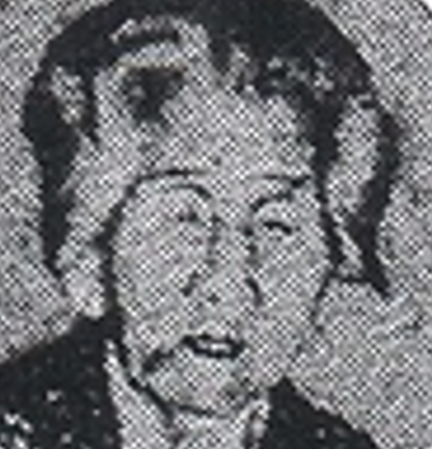
107 years old on 15 September 1966. (Source: Nagasaki Shimbun).
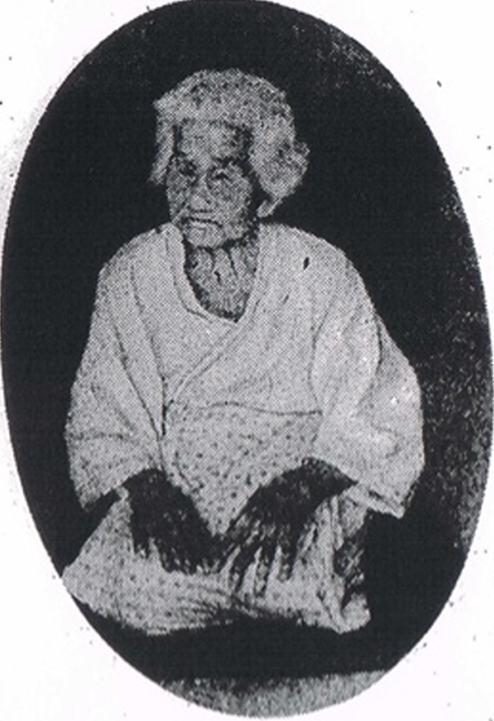
107 years old on 15 September 1966. (Source: Asahi Shimbun).
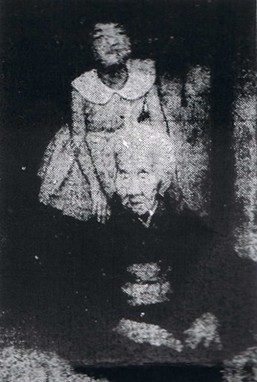
With her great-granddaughter Noriko, in September 1969. (Source: Nagasaki Shimbun).
RELATED PROFILES
Related posts:
[crp limit='4' ]